genderism
n. the pervasive and systemic belief in male/masculine and female/feminine as the only true, natural and correct gender identities and expressions

gender normativity n. the privileged state lived - whether momentarily or perpetually - by those whose genders perceptibly 'fit' with locally-derived and understood expressions of masculinity (for men) and femininity (for women)

gender non-normativity n. the oppressed state lived - whether momentarily or perpetually - by those whose genders do not perceptibly fit, as above
Showing posts with label pedagogy. Show all posts

Thursday, November 5, 2009

Teaching the Caster Semenya story: On the connections between gender, education and visual culture

I am currently taking an interdisciplinary doctoral course at York called Visual Culture and Gender, and we are engaging with the visual character of gender as well as the pedagogical implications for teaching with this visuality in mind. This post features an excerpt from a brief writing assignment wherein I connect gender, pedagogy and visuality in a 'teachable example' and centres on the Caster Semenya debacle.

--


Lorber (1993, p. 569) reminds us that gender as a binary has always been instantiated through seeing. As a teacher educator, I am required to engage with visual culture because public battles surrounding ‘gender’ – or, more frequently, biological sex – are fought in the realm of the visual. In recognition of this visuality of gender (and in unconscious preparation for this course), I have long collected visual texts complimentary of my anti-genderist pedagogical aims, and I discuss one of these texts here. The intense policing of sex practiced by international sport authorities has yielded an inalienable exemplar of a ‘public battle’ in the realm of the visual. Caster Semenya, the South African world track and field champion, has had her sex (gender?) publicly disputed on an international scale; in answer, the September issue of the popular South African magazine YOU responded both visually and discursively.

The September cover [inset above] contains a photograph of the newly- feminine Semenya, a smaller image of her ‘masculine’ alter ego, a statement discursively reifying Caster’s split (athletic/power vs. non-athletic/glamour) femininity – “We turned SA’s power girl into a glamour girl – and she loves it!” – and an enticing invitation to the viewer to consume this most unambiguous visual feast of true femininity: “Wow, look at Caster now!” The South African government has rallied around Caster by issuing scathing condemnations of the media and international athletic community. In light of this national rallying, that a South African publication is so firmly invested in the visually discursive reification and rendering intelligible of Semenya’s gender-normativity indicates that gender and visual culture can quickly become politicized in tandem, and on a global scale.

This cover is just one artefact of the visual culture of gender which, I would argue, can “shift the focus of analysis away from things seen toward the process of seeing” (Herbert, 2003, p. 455) and onto the ways in which this process is scaffolded by our own experiences of being gendered and being gender experts. Columpar (2002) aligns the colonial, ethnographic and male gazes “insofar as they accord their bearers a position of mastery and designate their objects as the site/sight of difference” (p. 40); I would add the gender-normative gaze for the same reasons. Analyzing the YOU cover with students will necessarily illuminate their own curiosity about Semenya’s gender as inflamed by the media, and in turn, the ways in which they exercise a gender-normative gaze when viewing visual texts and when appraising the genders of others. To this end, the pivotal question arising out of my engagement with visual studies, gender studies and teacher education pertains to the ethics of viewing and how I might foreground genderism and the process of seeing with a pedagogy disruptive of the gender-normative gaze. Just as Khan (2007) uses Hatoum’s work to pedagogically disrupt ‘racial seeing’ in the Women’s Studies classroom (p. 330), how can I seek to deflect the teacher’s eye from ‘gendered seeing’?

Saturday, April 11, 2009

Resource Spotlight - REVOLUTIONARY ROAD

INFO...

Revolutionary Road
Dir. Sam Mendes Prod. John N. Hart, Scott Rudin and Bobby Cohen
(C) Dreamworks Pictures, 2008.

PREAMBLE...

I have to admit that I watched Revolutionary Road on an Air Canada flight to San Diego, and it was my second choice after Valkryie (apparently Tom Cruise is more interesting to me than Kate Winslet these days - what's up with that?). I wasn't expecting to have my pedagogical brain so delightfully tickled, depite my having heard wonderful things about the film. Suffice it to say that I was completely taken with the film's possibilities for teaching about the evils of genderism and compulsory gender normativity in such a way that absolutely and totally abrogates the use of the 'Others'. I intend to teach with outtakes from this film in the future.

[On a side note (and in keeping with my Tom Cruise/Kate Winslet observations above), I went to see The Curious Case of Benjamin Button a few months back and - apparently barraged with mainstream movie propaganda these days - kept wondering why Kate Winslet hadn't shown up yet given how much she is probably paid to be in movies. "What a waste," I thought, all the while confusing her with Cate Blanchett. Deary me.]

GOOD FOR...

Although multiple moments throughout the film capture and reinforce the message of the first 15 minutes, I would start by screening everything prior to the credits. We meet Frank (between/among jobs) and April (studying to be an actress) on the night of their first meeting whereupon the passion they have for each other is palpable. This suddenly cuts to Frank watching his now wife April in a terrible suburban community theatre production when the players are taking their bows and members of the audience are voicing their disapproval all around him. Frank feels as though he is being very nice and understanding, and becomes angry on the way home on April testily rejects his efforts at being supportive of her in spite of the play's flop (i.e. "Honey, you were the only person in that play!" etc.). This erupts into a full-scale battle at a rest stop on the way home wherein they have an incredibly abusive argument about why they moved to the suburbs (the theme of the film) and how they each feel put upon by the consequences. This culminates in April saying something to the effect of "You aren't a man, you're a stupid, etc. little boy" and "Look at me and tell me in what way you could possible call yourself a man". Frank reacts in anguish and raises his fist to punch April, only to hold back and punch the car instead, twice. April responds with a completely deadpan "Can we go home now?" and gets back into the car without waiting for his reply.

Believe it or not, but there is enough character development in this first 15 minutes or so to ground what is happening between them, and to distance it from conventional narratives of 1950s-????s 'absentee career husband' vs. 'desperate suburban housewife'. This distancing complicates the standard narrative of sexism, misogyny and male domestic violence, throwing genderism into relief in a very teachable way. Further, throughout the film Frank's provider and protector masculinity is repeatedly challenged by other characters, alienating him from his wife and their revolutionary plans to flee to Paris. I would argue that masculinity is the villain in this film, with both characters being subjected by and implicated in its deployment.

When Frank winds up to punch April, this moment stands in for the film as a whole in that doing heteronormative masculinity successfully is shown to be excruciating. It is April's deployment of genderist shaming that drives Frank to the brink of violence and not his inherent maleness. We are confronted by the degree to which 'doing masculinity right' is so heavily dependent on the acceptance and recognition of heteronormatively feminine women; in many ways, gender itself is revealed as violent outside of the usual formula of [men/violence/badness | women/non-violence/goodness] that so abounds in popular culture. I firmly believe that students could grasp the harm of stringent gender normativity and genderism using this film is a touchstone. Best of all, it is absolutely applicable to their own lives as (largely) heterosexual and gender normative student teachers (who grew up in the shadow of The Titanic, where Kate/Leonardo first met...).

DRAWBACKS...

Of course, this is a film about white middle-class suburban people at a time in American history where segregation was in full swing; however, there are no people of color in the film. Granted, it takes place in Connecticut, but that does not mean that the raced (and thereby classed) context of white, suburban hegemonic masculinity is in no way influenced by a climate of white supremacy. This is perhaps not entirely a drawback, as discussions on the implications of this absence (and I would hazard a guess that students would argue that segregation is 'irrelevant to the film's events') could lead to pedagogical moments wherein Hollywood representations are revealed as white, middle-class, etc. and created for white, middle-class people (i.e. I doubt that the exclusion of people of color from the film would be seen as 'irrelevent' by everyone). Here I would repeat my qualifier regarding the necessity of having experience with anti-racist education when inter alia confronting white students about their whiteness.

And watch out - there is sex in the movie (if this is a problem for you).

BOTTOM LINE...

Revolutionary Road provides an exemplary anthropological account of how terrible gender normativity can be for the people who do it very well and who are never conceived as outside of its strictures. A variety of activities could stem from this, including individual analyses of the role of a particular scence within the film's total depiction of masculinity, problem-solving for the couple from an anti-genderist standpoint, representation issues (as above), etc. An entirely teachable film for anti-genderist education - when I have used it I will report on its effectiveness.

Saturday, April 4, 2009

Education that always already links genderism with racism and classism

In my formulation (see the definitions below the header), gender-normativity involves the qualifiers 'locally' and 'momentarily or perpetually'. I think that it's important to be clear on what I mean by including these qualifiers, and this is excerpt from my upcoming AERA conference paper spells out the main reason why I include them: doing anti-genderism in coalition with other anti-oppression projects.

--

I use the terms genderism, gender-normativity and gender non-normativity to denote a project that differs from the approach I have discussed. I define genderism as the pervasive and systemic belief in male/masculine and female/feminine as the only natural and acceptable gender identities and expressions. Gender-normativity is the privileged state lived, whether momentarily or perpetually, by those whose genders perceptibly 'fit' with locally-derived norms of (usually but not always) masculinity for those assigned male and femininity for those assigned female. On the other hand, gender non-normativity is the oppressed state lived, whether momentarily or perpetually, by those whose genders do not fit locally-derived norms for their assigned sex. In these definitions, the spatial qualifier ‘locally’ and the temporal qualifiers ‘momentarily or perpetually’ align with two reasons why I have found it necessary to generate or reclaim (see Airton, 2009a; 2009b) this terminology.

First, the spatial qualifier ‘locally’ names gender as inextricable from race and class. As a white gender non-normative queer, it is all-too-easy for me to elide my whiteness and, in the history of my family, my consequent middle-classness by highlighting the social traumas of my youth and the harassment that I face in clothing stores or on the bus. Because I have my parents’ whiteness, I will perpetually have access to the liberal space of higher education where my gender non-normativity will always flourish. Similarly, in asking students to name a new source of oppression in their lives (genderism), I am responsible for ensuring that white students do not elide their white privilege in the process. I do anti-racism and anti-genderism at the same time by keeping ‘gender’ local.

In my framing of it, ‘gender is generous’. The meaning of ‘generous’ is two-fold. First, if your gender accords with the norms of your community, you are given certain rights and freedoms there. Second, if you are of the dominant culture (white, middle-class, heterosexual, Anglophone, male/masculine or female/feminine and Christian) your rights and freedoms follow you everywhere. This is because your culture controls how power relations are structured through discourse and representation. Everyone has a local context wherein they are gender-normative and we have all had to learn how to do that gender-normativity. The gender-normativity privileged by the dominant culture, however, is only available to a few by virtue of their race, class, sexuality, etc. and the degree to which these are legible.

I will now move on to the temporal qualifiers ‘momentarily or perpetually’. These invoke the critical importance of examining one’s own experiences of gender-normative privilege or gender non-normative oppression, however fleeting these may be. In my experience, education on gender beyond the binary often begins with definitions of Other identities such as transsexual, transgender or intersex. This is intended to provoke students into realizing that gender is more than man or woman. In reality, however, most people who occupy these Othered spaces firmly identify as men or women. Homophobia and transphobia are consequently identified as the oppressions that police the boundaries between these Others and Ourselves. Even if we broaden homophobia and heterosexism to include their terrible effects upon heterosexuals who are momentarily or perpetually read as queer, their associations with queerness still preclude heterosexual students from naming themselves as subjected to them. And while transphobia denotes a gender-based oppression, it is only invoked if the recipient is transgender or transsexual, whether or not they live or identify as trans and are so perceived by their oppressors (c.f. Lamble, 2008).

Anyone can do gender wrong and suffer the consequences, but these rarely named as flowing from a gender-based oppression to which everyone is susceptible (see Airton, 2009b). By contrast, within an anti-genderist framework everyone is at one time or another gender non-normative and subject to genderist oppression or coercion for this failure to conform. I required new concepts that separated gender and sexuality with which to prompt largely gender-normative and heterosexual pre-service teachers to look critically at their own genders and name the processes that brought them to that – usually – male or female place. This is necessary for students to recognize the contingent nature of all genders, particularly their own. In direct opposition to the dominant mode of gender in teacher education that sees the individual as expert on everyone else’s gender while simultaneously denying that gender is individual, an anti-genderist pedagogy foregrounds the individual. My doctoral research will explore whether students of anti-genderist pedagogies understand themselves as contingent instead of model gendered subjects and, as anti-genderist teachers, whether they try to combat genderist hegemony in their classrooms.

Wednesday, March 25, 2009

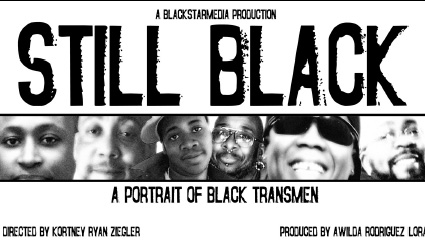
Resource Spotlight - STILL BLACK: A portrait of black transmen

This is the first installment in my series of 'Resource Spotlights' wherein I'll review a media text or article in terms of its pedagogical application for teaching on gender in keeping with the framework that I generally use for doing so.

--

INFO...

STILL BLACK: A portrait of black transmen
Dir. Kortney Ryan Ziegler. Prod. Awilda Rodriguez Lora
(C) Blackstar Media, 2009. B+W film.

PREAMBLE...

Let's say for the sake of argument that, contrary to the stance that I usually take on such things, I decided to teach with a film on trans lives as part of a course on identity politics for teacher education students. How could I do this in such a way that would invite a broader engagement with the issues than is usually the case when such 'trans' is brought up in this context? Can it be done without peddling trans as spectacle, on the one hand or, on the other, tacitly allowing students to distance themselves from their own complicity in gender-normativity by focussing on 'the Others' of sex and gender? I didn't used to think so, until I saw STILL BLACK.

From the website: STILL BLACK "is an alternative feature-length documentary that explores the lives of six black transgender men living in the United States. Through the intimate stories of their lives as artists, students, husbands, fathers, lawyers, and teachers, the film offers viewers a complex and multi-faceted image of race, sexuality and trans identity."

GREAT FOR...

The power of this film is in its quotidian representation of the ups and downs of living life. The lives lived happen to be those of black men who are trans or trans men who are black or men who are trans and black, etc. To the very limited extent that these men can be cast as a group, there is more within-group disparity among their wildly different self-representations, discourses and identities (as they express them) than there would be between one of these men and any audience member. However, one of the (very few) recurring themes across their accounts is coming to terms with their experiences of the devastating systemic racism habitually levied at black men in America. In the end, therefore, although the interviewees' narratives all make frequent reference to their individually embodied histories of gender, the pedagogical application that I foresee is the film's power to convey an understanding of racism that is uniquely powerful, perhaps even moreso if students are actively discouraged from dwelling on the 'trans-ness' of these lives in responding to/discussing the film.

For example, the film could be selectively screened by an instructor in order to foreground testimony related to racism, or the accounts in which racism is centrally addressed. A guided debrief activity could consist of students being required to discuss the film more broadly followed by an interrogation of their (if applicable - likely so, in my estimation/experience) focus on the 'trans-ness' of the excerpts and the two-fold implications of this focus: their avoidance of racism, and the politics of the trans-ness focus in line with what I have discussed before.

DRAWBACKS...

The drawbacks of using this film in teacher education (or any other kind of education) centre on racism as well, but of a different sort. Some of the interviewees espouse a point of view that is undeniably sexist and chauvinistic vis a vis their female partners or women in general. Although this discourse is certainly not endemic to the film as a whole, this portrayal of black masculinity will feel comfortable for a white or otherwise non-black audience insofar as this is the habitual racist representation thereof offered by mainstream white media. Challenging students' racism that leads to this comfort would be absolutely paramount in any pedagogical use of the film in order for the screening to be an anti-racist space.

BOTTOM LINE...

This is an excellent pedagogical tool - however, I would strongly discourage the film's use by instructor who does not have experience with anti-racist education and/or facilitation with white people and (if applicable) mixed groups.

Sunday, March 22, 2009

Teaching on 'trans' without tokenism in the university classroom

These are notes from a panel presentation I gave last fall for university faculty and instructors that was organized by the McGill Centre for Research and Teaching on Women.

I have a lot to say about how we should teach on gender. My research in teacher education informs my pedagogical practice as a gender non-normative person who leads tutorials in women's studies, lectures in teacher education courses, and facilitates workshops on gender and sexuality issues. In my experience, a great deal of anxiety is generated by the constructivist insistence that gender is socially constructed; in fact, I often find that students interpret this as an assertion that their genders – and, by extension, their very lives – are not real. By the same token, constructivist pedagogies of gender tend to take as a starting point trans and intersex lives as ‘teachable exemplars’ of gender ‘gone wrong’. These lives are often objectified and Othered in such a way so as to preclude the possibility that students might be driven to consider their own positionality in relation to gender normativity. Given that gender is a palpable and thick experiential category, I have found it useful to abandon the discourse of constructivism when teaching on gender. Borrowing from my involvement in anti-racist spaces and actions, I am interested in further developing a repertoire of pedagogical tools and techniques for implementing the intersectional concept of genderism and gender non/normativity in teacher education. I continue to seek out opportunities to engage in conversations on how to develop and deliver integrated and multifaceted pedagogies of anti-oppression wherein genderism is but one component of a total approach to reckoning with power dynamics in the classroom.


These notes spell out my concerns with regard to tokenistic constructivist teaching 'on' trans lives and trans issues in greater detail. Any/all comments welcome!

--

On the Others of sex and gender: Teaching without tokenism

TITLE – The title comments on a trend that I see and does not name trans people as Others because of their trans-ness; there are many other aspects to trans peoples’ lives. It refers instead to the process of other-ing that takes place when trans people are imported into an academic context.

It is pivotal to ask yourself why you are choosing to include these issues in your class: "Why am I discussing trans people?" Sub-questions include:

Is it because I want to better understand the issues they face?

Am I being specific to a particular time and place or am I generalizing?

Am I placing lives lived in their context (i.e., class, race, geography, etc.)?

OR is it because I want to use an example to demonstrate a theory? Is it because I am using an intriguing, shocking or otherwise gripping example to pique the interest of my students?

Namaste reminds us that discussions of trans people particularly in women's studies classrooms are often used to broach the time honored question of identity categories and belonging with no consideration of intersections with race/class nor the material realities of those lives.

TWO THINGS TO KEEP IN MIND – Extreme and Spectacle

EXTREME - I often hear trans people brought up as extreme examples of nonconformity with gender norms. If we imagine that the average transman or transwoman identifies firmly as male and female respectively, then naming people who are living gender normative lives as examples of gender non-conformity places them firmly in the context they have left behind, namely, their sex of rearing. To do so ignores the lived reality of trans people, many of whom do not identify as transgressively outside of the sex/gender binary. But it seems as though when discussing gender as a social construction we require the existence of people who we can name as having experienced gender as being wrong, as though the wrongness exposes the social construction. Just as Mohanty and other postcolonial feminist theorists have reminded us, the language we construct our others shows us more about ourselves than anyone else. In the case of constructivism and trans people, if we can go to trans lives in order to talk about the social construction of gender we can allay student fears that their own genders are somehow not real. This is dishonest to our students and disrespectful to trans people.

This process of making trans people strange, freakish or outlandish only serves to create barriers between the gender theory students study in their own self understanding as gendered subjects. I believe this makes for very poor pedagogy, in addition to being transphobic and just plain inappropriate. Not only does this create trans lives as spectacle for non-trans people to take in from the comfort of their own seemingly solid gender identities, but it effectively disallows students from theorizing their gender. As such, when I must teach about trans politics or bring up trans lives in a lecture or workshop, I take a cue from postcolonial theory and do my very best to reverse their relationship of center and periphery, instead making normative gender expressions and identities the material under study.

SPECTACLE - In addition to the inappropriateness of rolling out trans lives as teachable examples of exactly what gender does when it goes wrong (as if to imply that it goes right for anyone), teaching about trans people as arm's-length exemplars of an otherwise abstract notion allows the discursive treatment of trans people as specimens. This allows the hyper surveillance of trans people's bodies so evident in the mass media to infiltrate the classroom. Trans activists have asked that when discussing trans people's lives in an academic context, we use our considerable capital and time (both of which are often not so considerable in the lives of trans people, particularly male to female transsexuals) to investigate the barriers faced by trans people in institutions and in securing the necessities of daily life. Unfortunately, most of the time we tend to give in to student curiosity fueled by the media; they want to know about surgery. This focus on the bodies and genitals of trans people often governs their access to the media. For example, well-known transgender antipoverty activist and lawyer Dean Spade recalls the following on his (old) blog:

“For the last month this guy from the major legal newspaper of Southern California has been working on a profile about me and my work at UCLA that keeps not being run by the paper. He told me the editor he works under refuses to run the story unless it includes whether or not I’ve had “the surgery.” I have told him I will not reveal my genital status to the readers of this paper, and that I don’t think any of the other lawyers and law scholars who get profiled do so, so I don’t see why its necessary to my profile. The reporter was understanding, and kept re-editing the piece, trying to make the editor satisfied without describing my privates.”

In the end the piece never ran. My pedagogy with respect to teaching on trans issues is grounded by the insistence that I will not discuss the status of anyone's genitalia prior to considering their identity and material conditions. This is a privilege afforded to non-trans people, and I do my best to afford this privilege to trans people when I lecture.

CONCLUSION

I’d like to encourage you to ask yourselves the why question, and if you can, choose other examples or encourage students to scrutinize themselves.