INFO...
Revolutionary Road
Dir. Sam Mendes Prod. John N. Hart, Scott Rudin and Bobby Cohen
(C) Dreamworks Pictures, 2008.
PREAMBLE...
I have to admit that I watched Revolutionary Road on an Air Canada flight to San Diego, and it was my second choice after Valkryie (apparently Tom Cruise is more interesting to me than Kate Winslet these days - what's up with that?). I wasn't expecting to have my pedagogical brain so delightfully tickled, depite my having heard wonderful things about the film. Suffice it to say that I was completely taken with the film's possibilities for teaching about the evils of genderism and compulsory gender normativity in such a way that absolutely and totally abrogates the use of the 'Others'. I intend to teach with outtakes from this film in the future.
[On a side note (and in keeping with my Tom Cruise/Kate Winslet observations above), I went to see The Curious Case of Benjamin Button a few months back and - apparently barraged with mainstream movie propaganda these days - kept wondering why Kate Winslet hadn't shown up yet given how much she is probably paid to be in movies. "What a waste," I thought, all the while confusing her with Cate Blanchett. Deary me.]
GOOD FOR...
Although multiple moments throughout the film capture and reinforce the message of the first 15 minutes, I would start by screening everything prior to the credits. We meet Frank (between/among jobs) and April (studying to be an actress) on the night of their first meeting whereupon the passion they have for each other is palpable. This suddenly cuts to Frank watching his now wife April in a terrible suburban community theatre production when the players are taking their bows and members of the audience are voicing their disapproval all around him. Frank feels as though he is being very nice and understanding, and becomes angry on the way home on April testily rejects his efforts at being supportive of her in spite of the play's flop (i.e. "Honey, you were the only person in that play!" etc.). This erupts into a full-scale battle at a rest stop on the way home wherein they have an incredibly abusive argument about why they moved to the suburbs (the theme of the film) and how they each feel put upon by the consequences. This culminates in April saying something to the effect of "You aren't a man, you're a stupid, etc. little boy" and "Look at me and tell me in what way you could possible call yourself a man". Frank reacts in anguish and raises his fist to punch April, only to hold back and punch the car instead, twice. April responds with a completely deadpan "Can we go home now?" and gets back into the car without waiting for his reply.
Believe it or not, but there is enough character development in this first 15 minutes or so to ground what is happening between them, and to distance it from conventional narratives of 1950s-????s 'absentee career husband' vs. 'desperate suburban housewife'. This distancing complicates the standard narrative of sexism, misogyny and male domestic violence, throwing genderism into relief in a very teachable way. Further, throughout the film Frank's provider and protector masculinity is repeatedly challenged by other characters, alienating him from his wife and their revolutionary plans to flee to Paris. I would argue that masculinity is the villain in this film, with both characters being subjected by and implicated in its deployment.
When Frank winds up to punch April, this moment stands in for the film as a whole in that doing heteronormative masculinity successfully is shown to be excruciating. It is April's deployment of genderist shaming that drives Frank to the brink of violence and not his inherent maleness. We are confronted by the degree to which 'doing masculinity right' is so heavily dependent on the acceptance and recognition of heteronormatively feminine women; in many ways, gender itself is revealed as violent outside of the usual formula of [men/violence/badness | women/non-violence/goodness] that so abounds in popular culture. I firmly believe that students could grasp the harm of stringent gender normativity and genderism using this film is a touchstone. Best of all, it is absolutely applicable to their own lives as (largely) heterosexual and gender normative student teachers (who grew up in the shadow of The Titanic, where Kate/Leonardo first met...).
DRAWBACKS...
Of course, this is a film about white middle-class suburban people at a time in American history where segregation was in full swing; however, there are no people of color in the film. Granted, it takes place in Connecticut, but that does not mean that the raced (and thereby classed) context of white, suburban hegemonic masculinity is in no way influenced by a climate of white supremacy. This is perhaps not entirely a drawback, as discussions on the implications of this absence (and I would hazard a guess that students would argue that segregation is 'irrelevant to the film's events') could lead to pedagogical moments wherein Hollywood representations are revealed as white, middle-class, etc. and created for white, middle-class people (i.e. I doubt that the exclusion of people of color from the film would be seen as 'irrelevent' by everyone). Here I would repeat my qualifier regarding the necessity of having experience with anti-racist education when inter alia confronting white students about their whiteness.
And watch out - there is sex in the movie (if this is a problem for you).
BOTTOM LINE...
Revolutionary Road provides an exemplary anthropological account of how terrible gender normativity can be for the people who do it very well and who are never conceived as outside of its strictures. A variety of activities could stem from this, including individual analyses of the role of a particular scence within the film's total depiction of masculinity, problem-solving for the couple from an anti-genderist standpoint, representation issues (as above), etc. An entirely teachable film for anti-genderist education - when I have used it I will report on its effectiveness.
Showing posts with label resource spotlight. Show all posts
Showing posts with label resource spotlight. Show all posts
Saturday, April 11, 2009

Wednesday, March 25, 2009
Resource Spotlight - STILL BLACK: A portrait of black transmen
This is the first installment in my series of 'Resource Spotlights' wherein I'll review a media text or article in terms of its pedagogical application for teaching on gender in keeping with the framework that I generally use for doing so.
--
 INFO...
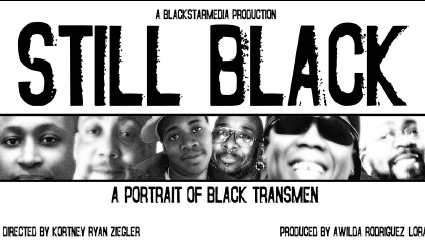
STILL BLACK: A portrait of black transmen
Dir. Kortney Ryan Ziegler. Prod. Awilda Rodriguez Lora
(C) Blackstar Media, 2009. B+W film.
PREAMBLE...
Let's say for the sake of argument that, contrary to the stance that I usually take on such things, I decided to teach with a film on trans lives as part of a course on identity politics for teacher education students. How could I do this in such a way that would invite a broader engagement with the issues than is usually the case when such 'trans' is brought up in this context? Can it be done without peddling trans as spectacle, on the one hand or, on the other, tacitly allowing students to distance themselves from their own complicity in gender-normativity by focussing on 'the Others' of sex and gender? I didn't used to think so, until I saw STILL BLACK.
From the website: STILL BLACK "is an alternative feature-length documentary that explores the lives of six black transgender men living in the United States. Through the intimate stories of their lives as artists, students, husbands, fathers, lawyers, and teachers, the film offers viewers a complex and multi-faceted image of race, sexuality and trans identity."
GREAT FOR...
The power of this film is in its quotidian representation of the ups and downs of living life. The lives lived happen to be those of black men who are trans or trans men who are black or men who are trans and black, etc. To the very limited extent that these men can be cast as a group, there is more within-group disparity among their wildly different self-representations, discourses and identities (as they express them) than there would be between one of these men and any audience member. However, one of the (very few) recurring themes across their accounts is coming to terms with their experiences of the devastating systemic racism habitually levied at black men in America. In the end, therefore, although the interviewees' narratives all make frequent reference to their individually embodied histories of gender, the pedagogical application that I foresee is the film's power to convey an understanding of racism that is uniquely powerful, perhaps even moreso if students are actively discouraged from dwelling on the 'trans-ness' of these lives in responding to/discussing the film.
For example, the film could be selectively screened by an instructor in order to foreground testimony related to racism, or the accounts in which racism is centrally addressed. A guided debrief activity could consist of students being required to discuss the film more broadly followed by an interrogation of their (if applicable - likely so, in my estimation/experience) focus on the 'trans-ness' of the excerpts and the two-fold implications of this focus: their avoidance of racism, and the politics of the trans-ness focus in line with what I have discussed before.
DRAWBACKS...
The drawbacks of using this film in teacher education (or any other kind of education) centre on racism as well, but of a different sort. Some of the interviewees espouse a point of view that is undeniably sexist and chauvinistic vis a vis their female partners or women in general. Although this discourse is certainly not endemic to the film as a whole, this portrayal of black masculinity will feel comfortable for a white or otherwise non-black audience insofar as this is the habitual racist representation thereof offered by mainstream white media. Challenging students' racism that leads to this comfort would be absolutely paramount in any pedagogical use of the film in order for the screening to be an anti-racist space.
BOTTOM LINE...
This is an excellent pedagogical tool - however, I would strongly discourage the film's use by instructor who does not have experience with anti-racist education and/or facilitation with white people and (if applicable) mixed groups.
--
STILL BLACK: A portrait of black transmen
Dir. Kortney Ryan Ziegler. Prod. Awilda Rodriguez Lora
(C) Blackstar Media, 2009. B+W film.
PREAMBLE...
Let's say for the sake of argument that, contrary to the stance that I usually take on such things, I decided to teach with a film on trans lives as part of a course on identity politics for teacher education students. How could I do this in such a way that would invite a broader engagement with the issues than is usually the case when such 'trans' is brought up in this context? Can it be done without peddling trans as spectacle, on the one hand or, on the other, tacitly allowing students to distance themselves from their own complicity in gender-normativity by focussing on 'the Others' of sex and gender? I didn't used to think so, until I saw STILL BLACK.
From the website: STILL BLACK "is an alternative feature-length documentary that explores the lives of six black transgender men living in the United States. Through the intimate stories of their lives as artists, students, husbands, fathers, lawyers, and teachers, the film offers viewers a complex and multi-faceted image of race, sexuality and trans identity."
GREAT FOR...
The power of this film is in its quotidian representation of the ups and downs of living life. The lives lived happen to be those of black men who are trans or trans men who are black or men who are trans and black, etc. To the very limited extent that these men can be cast as a group, there is more within-group disparity among their wildly different self-representations, discourses and identities (as they express them) than there would be between one of these men and any audience member. However, one of the (very few) recurring themes across their accounts is coming to terms with their experiences of the devastating systemic racism habitually levied at black men in America. In the end, therefore, although the interviewees' narratives all make frequent reference to their individually embodied histories of gender, the pedagogical application that I foresee is the film's power to convey an understanding of racism that is uniquely powerful, perhaps even moreso if students are actively discouraged from dwelling on the 'trans-ness' of these lives in responding to/discussing the film.
For example, the film could be selectively screened by an instructor in order to foreground testimony related to racism, or the accounts in which racism is centrally addressed. A guided debrief activity could consist of students being required to discuss the film more broadly followed by an interrogation of their (if applicable - likely so, in my estimation/experience) focus on the 'trans-ness' of the excerpts and the two-fold implications of this focus: their avoidance of racism, and the politics of the trans-ness focus in line with what I have discussed before.
DRAWBACKS...
The drawbacks of using this film in teacher education (or any other kind of education) centre on racism as well, but of a different sort. Some of the interviewees espouse a point of view that is undeniably sexist and chauvinistic vis a vis their female partners or women in general. Although this discourse is certainly not endemic to the film as a whole, this portrayal of black masculinity will feel comfortable for a white or otherwise non-black audience insofar as this is the habitual racist representation thereof offered by mainstream white media. Challenging students' racism that leads to this comfort would be absolutely paramount in any pedagogical use of the film in order for the screening to be an anti-racist space.
BOTTOM LINE...
This is an excellent pedagogical tool - however, I would strongly discourage the film's use by instructor who does not have experience with anti-racist education and/or facilitation with white people and (if applicable) mixed groups.
Subscribe to:
Posts (Atom)
.bmp)


 Posts
Posts

